Cosmetic Bag Quality Control & Inspection Guide: How B2B Buyers Verify Seams, Zippers, and AQL Standards
Short answer: Professional cosmetic bag quality control requires an end-to-end inspection protocol across five critical stages: incoming raw material chemical and physical audits, in-process stitching and needle checks, semi-finished assembly verification, 100% finished product inspection against the golden sample, and pre-shipment AQL 2.5/4.0 random audits. Defect prevention hinges on verifiable pull-strength metrics, smooth zipper tolerances, colorfastness standards, and calibrated needle detection before final export packing.
For beauty brands, retailers, e-commerce wholesalers, and Amazon sellers, sourcing custom makeup bags from overseas factories presents measurable operational risks. A single production run with skipped stitches, stuck zippers, uneven piping, chemical odor, or misaligned custom logos can trigger retail returns, negative marketplace reviews, and delayed holiday product launches. Establishing a systematic quality control protocol ensures that every unit shipped from the factory floor matches your approved golden sample and complies with regional safety standards.
What is the standard 5-step quality control flow in cosmetic bag manufacturing?
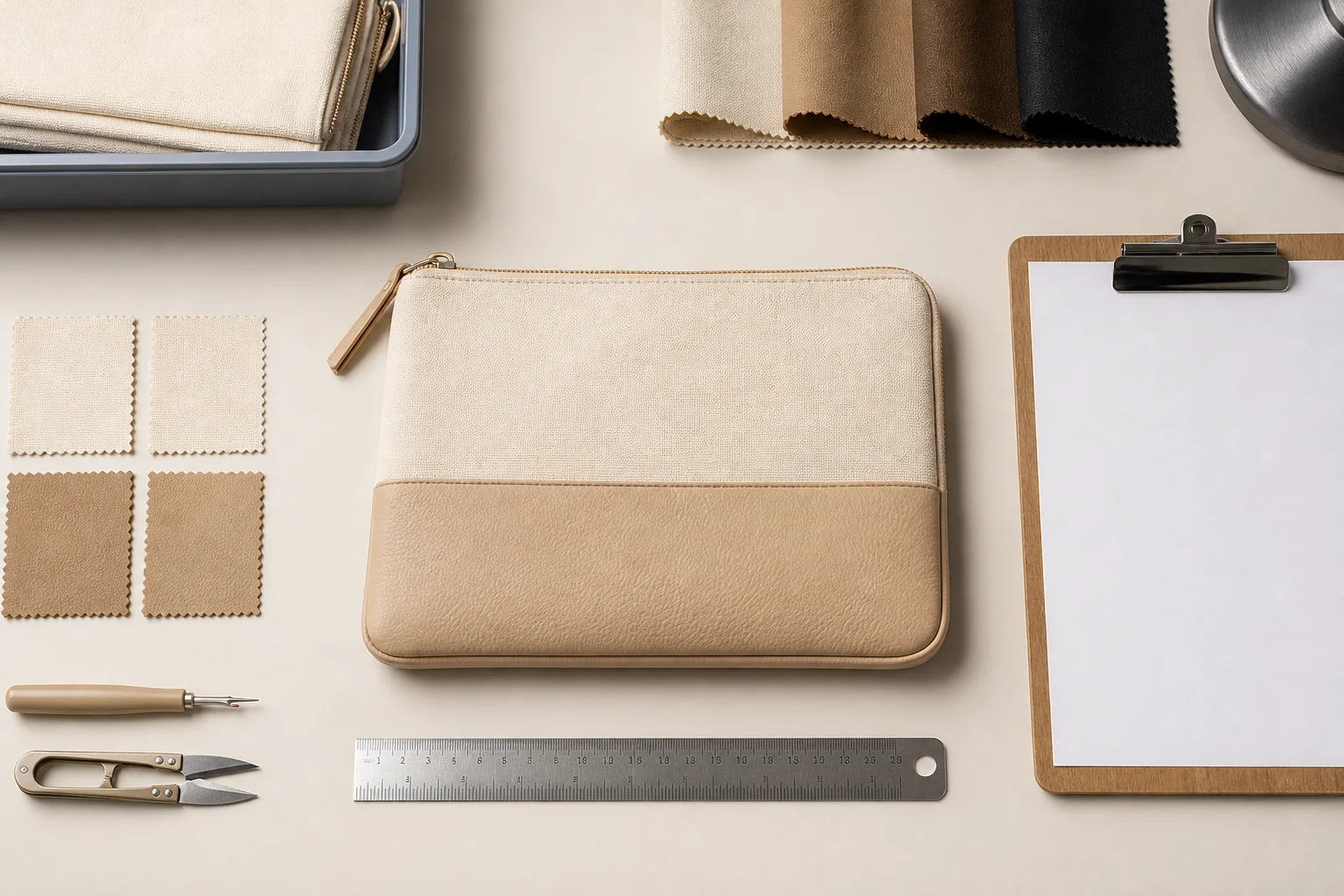
A mature bag manufacturer does not rely solely on end-of-line checking. Quality must be built into every manufacturing phase. At BEARKY, production follows a structured 5-step quality control flow that catches discrepancies at the earliest possible stage:
- Raw Material Inspection (IQC): Every fabric roll (PU leather, canvas, nylon, TPU, PVC, or RPET) and hardware batch is inspected upon arrival. Inspectors test for color consistency against Pantone swatches, thickness tolerances, coating adhesion, fabric weight, and verify compliance with EU REACH, California Proposition 65, and OEKO-TEX Standard 100 criteria.
- In-Process Quality Control (IPQC): Real-time on-line audits monitor computer-controlled sewing machines, edge painting, and die-cutting precision. Line leaders verify stitch per inch (SPI) counts, seam tension, and logo printing/embossing accuracy directly at the workstation.
- Semi-Finished Product Inspection: Assembled panels, zipper tracks, internal compartments, and lining structures are audited for dimensional accuracy and symmetrical alignment prior to final seam binding.
- 100% Final Product Audit (FQC): Every finished cosmetic bag is individually inspected. Inspectors test zipper cycles, seam pull resistance, handle load-bearing integrity, clean all loose threads, and verify clean-room cleanliness.
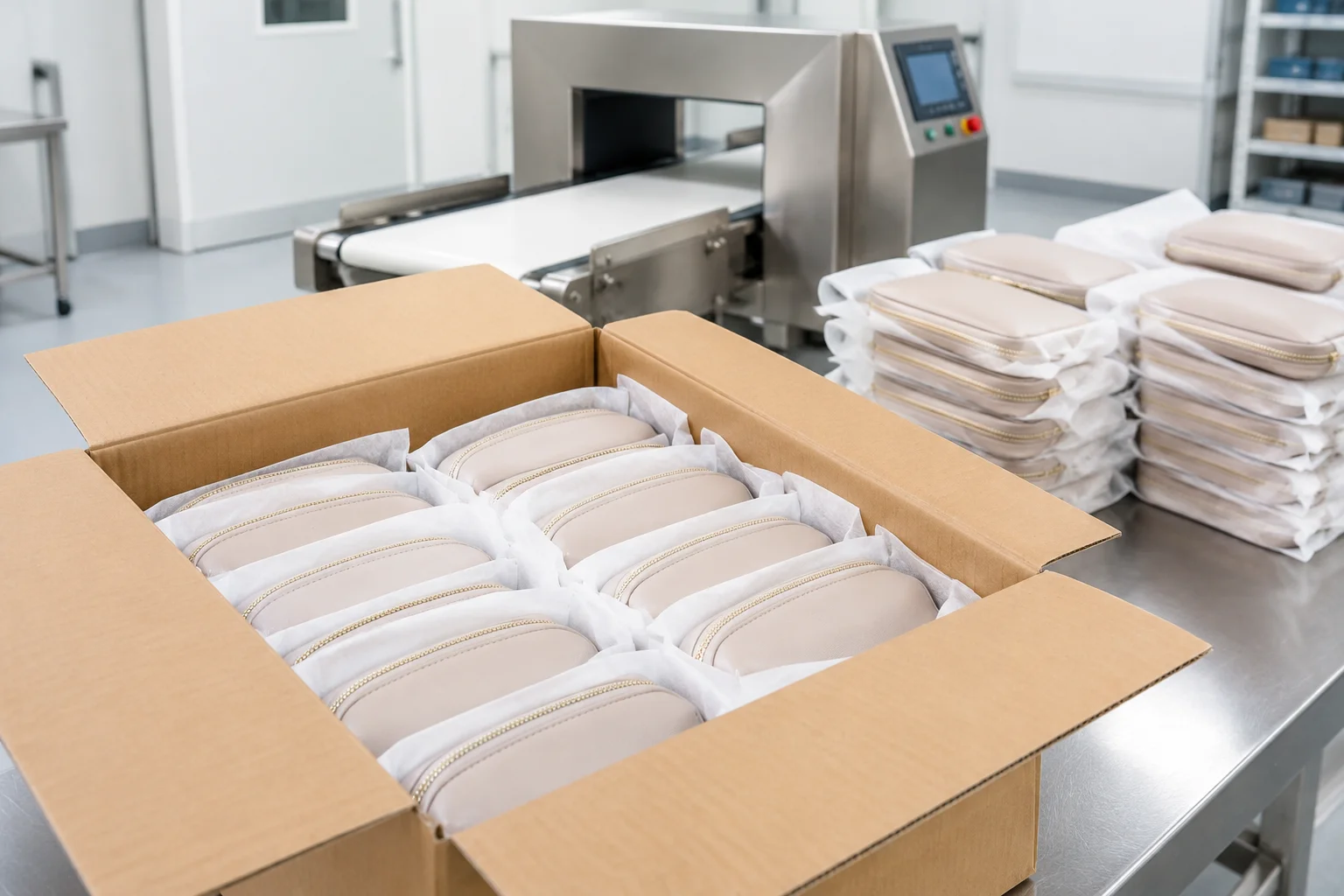
- Pre-Packaging Audit & Needle Detection (OQC): 100% of finished bags pass through an industrial needle detector to eliminate any broken needle hazard. Packaging teams then verify barcode labels, polybags, hangtags, carton drop-test durability, and master carton quantities.
Learn more about our production facilities and specialized machinery on the BEARKY factory tour page.
How should B2B buyers set AQL inspection levels for cosmetic bags?
When conducting third-party inspections or factory final audits, buyers use the ISO 2859-1 (ANSI/ASQ Z1.4) standard for Acceptance Quality Limit (AQL). In the sewn goods and cosmetic accessories sector, the international standard is General Inspection Level II with an AQL of 0 Critical / 2.5 Major / 4.0 Minor.
| Defect Category | AQL Limit | Definition & Failure Criteria | Common Examples in Cosmetic Bags |
|---|---|---|---|
| Critical Defects | 0.0 (Zero Tolerance) | Defects that compromise user safety, violate statutory regulations, or render the product legally unsellable. | Broken needle fragment inside lining, sharp metal burrs on zipper puller, heavy chemical odor / banned phthalate levels, mold or insect contamination. |
| Major Defects | 2.5 | Defects that impair product function, significantly reduce usability, or cause immediate retail consumer return. | Zipper teeth jamming or splitting under tension, open seam / broken stitches > 5mm, structural dimensions deviating > 10mm from spec, upside-down or misspelled logo, incorrect lining material. |
| Minor Defects | 4.0 | Cosmetic imperfections that do not affect function or structural durability but deviate from perfect craftsmanship. | Uncut loose thread ends < 10mm, minor removable surface dust, slight stitch tension waviness on internal lining, minor crease in soft PU leather packaging. |
What physical and functional tests must cosmetic bags pass?
Visual inspection is not enough for high-use travel organizers and beauty gift bags. Technical buyers require laboratory and on-site physical performance testing to ensure longevity under real-world usage:
1. Seam Strength & Stitch Density Test
Using calibrated tensile testing equipment conforming to ASTM D5034 standards, main structural seams should withstand a minimum pull force of 150 N (approx. 15 kgf) without seam slippage or fabric rupture. Stitch density should consistently hold 7 to 9 stitches per inch (SPI) depending on material thickness.
2. Zipper Cycle & Cross-Pull Strength Test
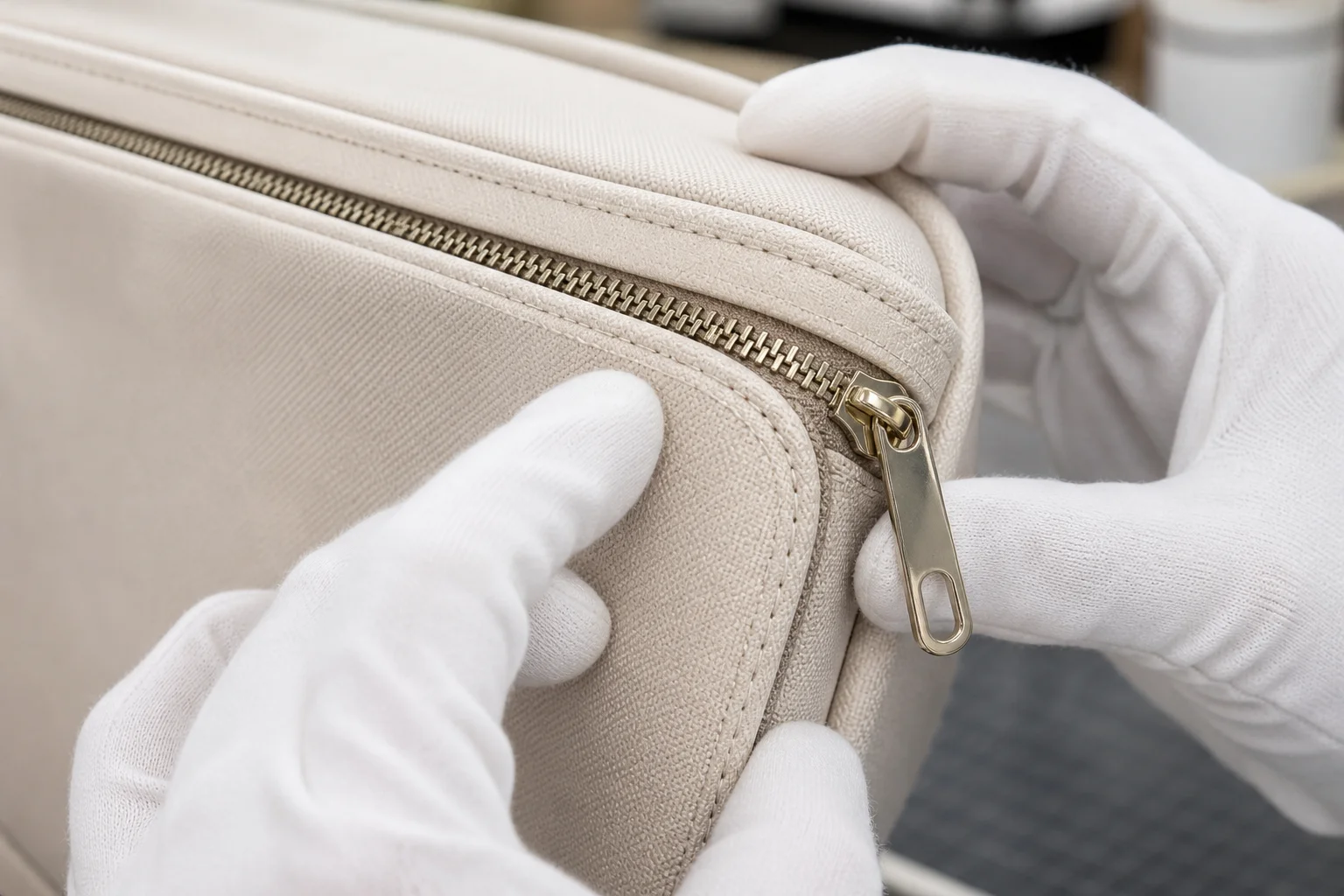
Zippers represent the most frequent point of failure in daily cosmetics storage. Following ASTM D2061 test methods, zipper sliders must operate smoothly across 500+ continuous open/close cycles without tooth misalignment, tape fraying, or slider detachment. Cross-pull strength on closed zipper teeth must meet or exceed 250 N for nylon coil and metal zippers.
3. Colorfastness & Rub Resistance
Cosmetics frequently contain oils, alcohol, and liquid pigments. Both exterior fabrics and inner linings must achieve a minimum Grade 4 rating in dry crocking tests and Grade 3.5 in wet crocking tests (AATCC 8 / ISO 105-X12), preventing color transfer to white vanity surfaces or clothing.
4. Handle & Strap Load-Bearing Drop Test
For large toiletry organizers and weekender bags such as the BEARKY Waterproof Weekender Cosmetic Organizer, top carry handles undergo static weight load testing (loaded with 5 kg for 4 hours) and dynamic jerk testing (20 cycles of 100mm drop) without seam tearing or rivet loosening.
How can B2B buyers prevent golden sample discrepancies in bulk orders?
A common pitfall in OEM/ODM bag manufacturing is "sample degradation"—where the prototype sample looks flawless, but mass production exhibits inconsistent workmanship. To eliminate this risk, professional buyers implement a Golden Sample Protocol:
- Produce Three Identical Counter-Samples: During the sampling stage, the factory produces at least three identical samples. One remains in the factory QA room, one is archived by the buyer, and one is provided to the third-party on-site inspection team.
- Attach a Signed Tech Pack to the Golden Sample: Every critical component—fabric code, Pantone color, zipper gauge, puller alloy, thread weight, lining denier, and foam padding thickness—is signed and sealed with a tamper-evident factory tag.
- Establish Acceptable Tolerance Ranges: Define allowable tolerances in writing (e.g., dimensions ±3mm, weight ±5%, Pantone color variation ΔE < 1.0) rather than relying on subjective terms like "commercial match".
- Include Approved Defect Defenses in the PO: Ensure purchase orders explicitly reference the golden sample and specify corrective action or factory refund terms for non-conforming bulk lots.
Frequently asked questions about cosmetic bag quality control
What is the difference between IQC, IPQC, FQC, and OQC in bag manufacturing?
IQC (Incoming Quality Control) tests raw fabrics and hardware before cutting. IPQC (In-Process Quality Control) monitors sewing and printing lines during production. FQC (Final Quality Control) inspects 100% of finished bags for cosmetic and functional integrity. OQC (Outgoing Quality Control) conducts random pre-shipment AQL audits and carton packaging verification before loading.
Why is 100% needle detection mandatory for custom cosmetic bags?
During high-speed sewing, fine industrial needles can snap and embed tiny metal shards inside multi-layer linings or padded foam. Industrial calibrated needle detector conveyor systems ensure 100% of exported bags are free from ferrous contaminants, protecting end consumers and shielding brands from liability.
How do you verify whether a cosmetic bag lining is truly waterproof or leak-proof?
Water-repellent fabrics use surface DWR coatings, while true waterproof linings utilize TPU, PVC, or EVA laminations with sealed or heat-welded seams. In factory testing, QA teams place 100ml of liquid inside the pouch for 2 hours to confirm zero seam seepage.
Can third-party inspection agencies (SGS, Intertek, QIMA) inspect at BEARKY's factory?
Yes. BEARKY welcomes buyer-appointed third-party inspection teams (such as SGS, Bureau Veritas, Intertek, or QIMA) to conduct during-production (DUPRO) and final random inspections (FRI) under AQL II standards.
What chemical compliance certificates should a cosmetic bag factory provide?
Depending on the destination market, factories should provide current test reports for EU REACH (SVHC compliance, azo dyes, phthalates <0.1%), California Proposition 65 (lead <100ppm, cadmium <300ppm, phthalates), and OEKO-TEX Standard 100 for eco-friendly textiles.
What is the standard defect rate in bulk cosmetic bag manufacturing?
Under strict AQL 2.5 standards, the acceptable major defect threshold is under 2.5%. Premium OEM factories operating automated cutting and computerized sewing typically maintain real-world factory defect rates below 0.5% through in-line correction.
Editor review: Production capacity, machinery counts, certificate renewal dates, and project-specific MOQ tiers are subject to ongoing factory audits. Buyers should verify current lab test reports and signed golden sample parameters with BEARKY before placing bulk purchase orders.
Send BEARKY your tech pack, reference design, or custom sample requirements. Request a free quote, certified material swatches, and a customized quality inspection plan through our BEARKY Contact Portal.
Reference Sources & Quality Standards
- ISO 2859-1: Sampling procedures for inspection by attributes (AQL Sampling Standards)
- ASTM D5034: Standard Test Method for Breaking Strength and Elongation of Textile Fabrics
- ASTM D2061: Standard Test Methods for Strength Tests for Zippers
- European Commission: REACH Regulation (EC No 1907/2006) for Chemical Safety
- California OEHHA: Proposition 65 Safe Harbor & Phthalate Limits



.jpg)